

AI is moving into a new era – an era where chatbots and other prompt-based applications are left behind in the past. The emergence of autonomous agents such as the ones developed by OpenClaw has made many companies begin considering a world where software does not only answer prompts but also continues working in the background without the need for human supervision. This change has been emphasized in NVIDIA’s latest blog post.
From Prompt-Based AI to Autonomous Agents
The functioning of current AI applications, whether they are generative models or otherwise, always follows the same basic structure. After receiving a prompt from the user, these applications provide a response to it. Yet, OpenClaw offers a totally different concept.
These agents have a heartbeat system, and rather than requiring commands, these systems constantly monitor processes, determine what needs attention, and respond accordingly. As such, they become perfect in applications that involve continuous monitoring and decision making.
A New Wave of AI Development
As described by NVIDIA, there have been four waves in the development of artificial intelligence, namely predictive AI, generative AI, reasoning AI, and finally autonomous AI. The need for computational resources increased significantly during each of these stages. Autonomous agents such as OpenClaw further raise this number up to 1,000 times more in inference compared to reasoning AI.
The increased computational needs are directly related to the capabilities of autonomous agents. They can run continuously and handle intricate workflows in a way that was never possible before. An AI agent might be able to process thousands of variations of something overnight or monitor a process continuously.
Under Which Circumstances Should Companies Deploy “Claws”?
An agent isn’t needed for all activities, as per the observations of NVIDIA researchers, who point out that OpenClaw-type technologies are best used in certain situations:
Activities that need constant observation such as system maintenance and financial accounting work well with agents that operate around the clock.
Processes that have thousands of iterations.
Situations where actions are expected of AI rather than recommendations—for example, performing database updates and API calls.
To summarize, OpenClaw-type agents are better utilized when the workflow is repetitive, lengthy, and action-based.
Real-Life Use Cases in Many Industries
Autonomous agents can be used in almost all industries:
Finance: Agents watch for changes in trade systems and regulation policies, highlighting any significant change instantly.
Healthcare and medicine research: Agents review academic articles and automatically update their database, eliminating days of manual labor.
Engineering and production: AI agents analyze many different options to find the best possible solution over the course of a night.
IT management: Agents detect problems, solve simple issues automatically, and forward more complicated cases only.
This list demonstrates how companies can go from reactive processes to proactive ones.
NVIDIA’s NemoClaw Emerges
Though OpenClaw brings much to the table, it is not without its problems. The autonomous agent has the ability to access and execute files, as well as interact with live systems – both advantages and drawbacks.
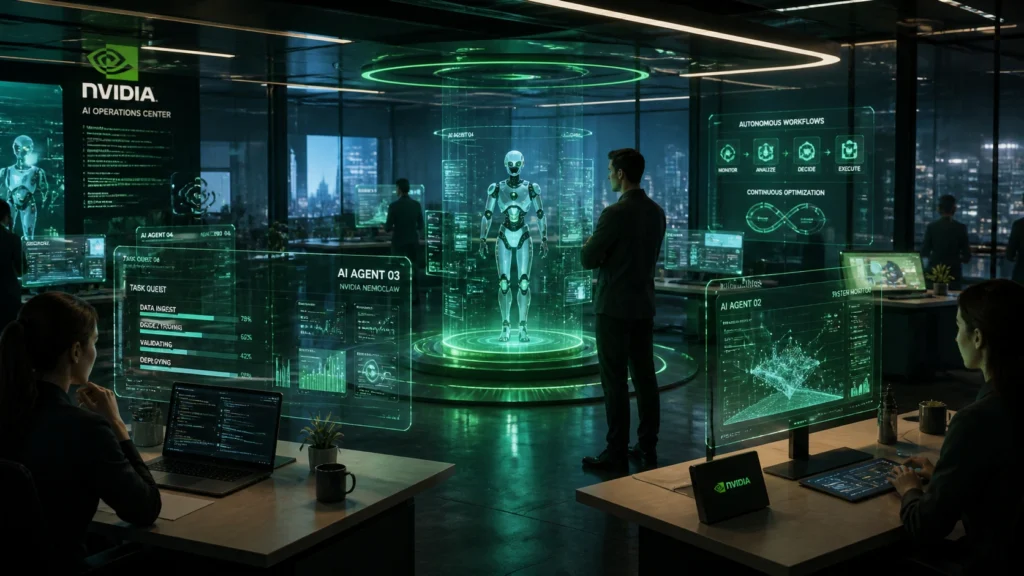
In response to this situation, NVIDIA created a reference implementation called NemoClaw that adds a layer of security to OpenClaw implementations through secure runtimes, policies, and enhanced networking.
Security and Governance Issues
The advent of autonomous agents has led to a discussion among tech experts. Since these autonomous agents work on their own, any malfunctioning or vulnerability may result in tangible implications. For example, an improperly configured autonomous agent may leak confidential information or carry out unauthorized tasks.
Experts in research and development have warned of the security challenges related to aspects such as authentication, data protection, and dangers associated with open-source software.
To address the above-mentioned challenges, organizations must approach the matter of governance with the utmost importance. This involves the observati
The Future of Work with Self-Sufficient AI
In contrast to traditional ways where humans always have to interface with tools, self-sufficient AI is taking center stage and enabling work to be performed without any need for intervention.
Nevertheless, adopting this approach needs companies to change their attitudes towards innovation as well. They have to ensure that autonomous operations do not come with any risks.